
- Published by
- Raman Choudhary at
- 13th September 2026
- 6 min read
What Is a Generator Radiator? How It Works and Its Main Components
Quick Answer:
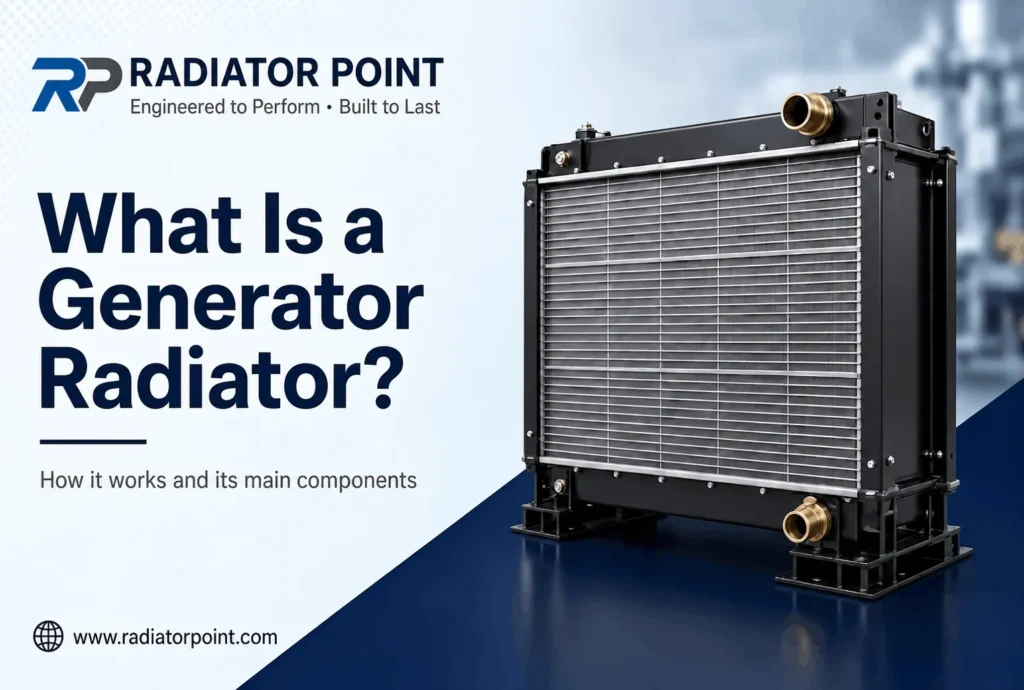
A generator radiator is the heat exchanger on a liquid-cooled diesel generator. Hot engine coolant flows through it. Air moving across the core takes up that heat. Cooler coolant then returns to the engine.
It is not the generator, and it is not the whole cooling system. The water pump moves the coolant. The thermostat decides when that coolant is sent to the radiator. The radiator is where heat leaves the coolant and passes into the air.
Radiator Point manufactures radiators for diesel generator sets. This page explains the component: what it is, what it does, and how it works.
What is a Generator Radiator?
On a liquid-cooled DG set, the radiator is the heat exchanger. Everything else in the circuit exists to get hot coolant into it and air across it.
Four things get mixed up on site:
- The generator set is the full package: engine, alternator, cooling system, controls, and often an enclosure.
- The engine makes power and heat.
- The cooling system is the full circuit: coolant, pump, thermostat, hoses, tanks, fan, and radiator.
- The radiator is the heat exchanger in that circuit.
The radiator cannot work on its own. It needs circulating coolant and air through the core.
This article covers liquid-cooled generator engines. Many smaller sets are air-cooled and do not use a coolant radiator.
What Does a Generator Radiator Do?
The radiator cools the coolant. It does not cool the engine metal directly.
Coolant first picks up heat in the engine water jackets. That heat still has to leave the circuit. The radiator is where it leaves. Hot coolant enters the core. Heat moves into the air. Cooler coolant returns toward the engine.
Two conditions decide whether that happens.
During warm-up, the thermostat keeps most of the coolant inside the engine so the set can reach operating temperature. The radiator only sees full flow once the thermostat opens.
On the air side, the fan and shroud have to move air through the core, not around it. No flow, or no airflow, means little heat rejection; even if the radiator itself is sound.
How Does a Generator Radiator Work?
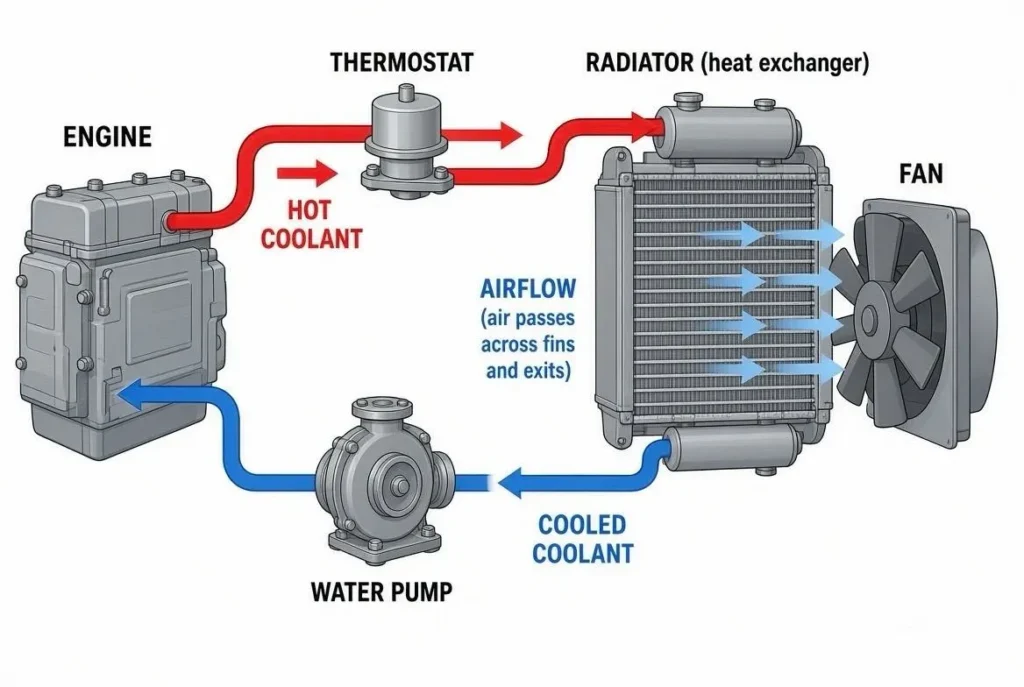
The radiator is one stage in a closed cycle:
- Table of Contents
- Need a Generator Radiator?
We manufacture and supply high quality generator radiators and cooling solutions for a wide range of DG Sets.
1
The engine produces heat during combustion and friction.
2
Coolant absorbs that heat as the water pump drives it through the engine jackets.
3
Hot coolant is sent to the radiator after the thermostat opens.
4
Heat moves through the core – from the coolant, through the tube walls, into the fins.
5
Airflow carries the heat away as a fan moves air across the core.
6
Cooled coolant returns to the engine, and the cycle repeats.
- Engine
- coolant absorbs heat
- hot coolant reaches the radiator
- heat transfers to airflow
- cooler coolant returns
Main Components of a Generator Radiator
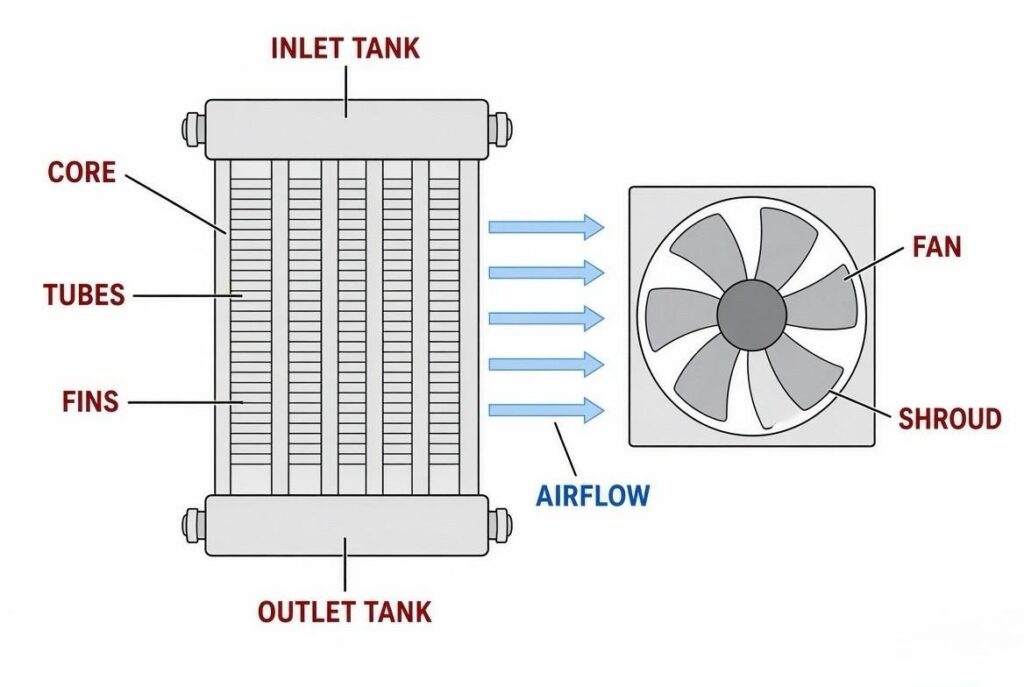
The pump and thermostat belong to the cooling circuit. They are not part of the radiator body.
Core: Tubes and fins. This is where coolant heat meets airflow.
Tubes: Carry coolant through the air stream.
Fins: Increase the surface exposed to air.
Header tanks: The inlet tank feeds the tubes; the outlet tank collects cooled coolant.
Fan and shroud: The fan supplies air; the shroud keeps that air moving through the core.
Hoses and connections: Close the path between engine and radiator.
Coolant: The fluid that carries heat from the engine to the radiator.
Why the Radiator Matters in the Cooling System?
A diesel engine puts a large share of unused fuel energy into the jacket-water circuit. That heat has to leave while the set is on load.If the radiator cannot reject it, coolant temperature rises and the engine runs with less thermal margin. The set may still make power. It is no longer clearing heat at the rate the engine is producing it.
The radiator is also the part of the circuit most open to the site. Dust and blocked discharge air hit the core first.
Conclusion
A generator radiator is the heat exchanger that lets engine coolant reject heat to air. The pump, thermostat, and fan decide whether that heat actually reaches the core and leaves it.
If you already know you need the radiator itself, start with Radiator Point’s DG set radiators, including assemblies for 250 kVA, 500 kVA, and 750 kVA sets. For a specification check, contact Radiator Point.
Frequently Asked Questions (FAQs)
Do all generators use a radiator?
No. Most industrial liquid-cooled sets do. Many smaller generators are air-cooled and have no coolant radiator.
Is the radiator the same as the cooling system?
No. The cooling system includes the pump, thermostat, coolant, hoses, tanks, fan, and radiator. The radiator is the heat exchanger in that system.
What happens if a generator radiator cannot remove enough heat?
Coolant temperature rises and the engine can run outside its intended range. How fast that becomes a problem depends on load, ambient conditions, and the rest of the circuit.